reflections
Post-Exam Reflection Journal: What to Record Before Your Next Paper
post exam reflectionstudentsexam reflectionstudy goalsvoice journaling
You have finished one exam, but your exam period is not over.
The next subject is already demanding your attention. Before you switch completely, a short post exam reflection can help you preserve what you noticed during the paper and decide what you want to change before the next one.
The point is not to grade yourself again. It is not to predict your result. And it is not to reconstruct every question from memory.
It is simply to record what you noticed while the experience is still easy for you to describe.
Why reflect after an exam?
A useful model already exists in education: the exam wrapper.
Carnegie Mellon University's Eberly Center describes exam wrappers as short reflections students complete around returned exams. They can include reviewing preparation, considering the kinds of errors made, and deciding what to do differently in the future. Cornell's Center for Teaching Innovation similarly describes exam wrappers as a way for students to reflect on how they prepared and what they might change next time.
You do not need to turn your own reflection into a formal assessment exercise.
For a student with several papers close together, the useful question is simpler:
What did this exam teach me about how I want to approach the next one?
Sources: Carnegie Mellon University — Exam Wrappers and Cornell University — Self-Assessment.
Don't try to reconstruct the whole paper
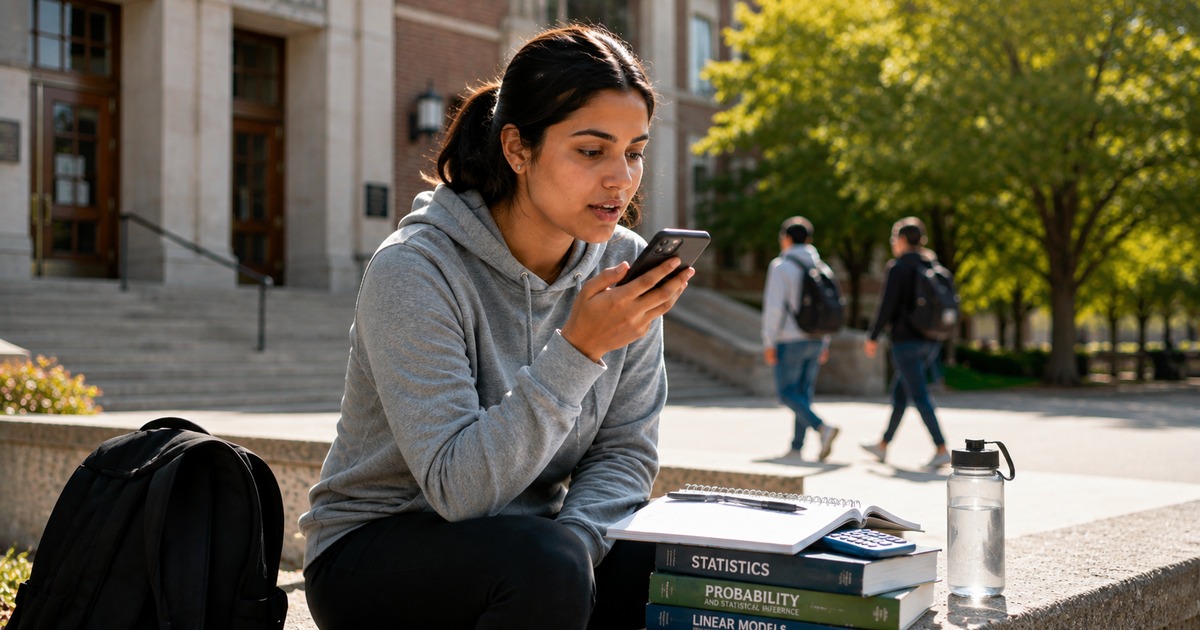
Imagine you have just finished a difficult university statistics exam.
Some questions felt familiar. One section caught you off guard. You noticed that one revision method was useful, while another left you less prepared than you expected.
Your reflection does not need to become a second copy of the exam.
Instead, focus on the parts that can inform your own next decision.
You might record:
- what surprised you;
- what preparation felt useful during the exam;
- where you felt underprepared;
- what you want to change before your next paper.
That keeps the reflection about your preparation and choices, rather than trying to calculate a score you do not yet have.
What surprised you?
Start with the unexpected.
Maybe the statistics paper used a familiar concept in an unfamiliar way. Maybe a topic you expected to dominate barely appeared. Maybe you understood the material but found yourself spending more time than expected on one type of question.
Record the observation without turning it into a verdict.
For example:
“I expected the probability section to be the hardest part, but I actually struggled more with interpreting the regression questions.”
That is enough. You are preserving what you noticed.
What preparation actually helped?
Next, think about what you did before the exam that felt useful while you were sitting it.
Perhaps working through practice problems made certain question formats feel familiar. Perhaps your summary notes helped you recall definitions. Perhaps explaining a concept aloud made it easier for you to recognize what a question was asking.
You do not have to prove that a method “works” universally.
Just record your own observation:
“The practice questions were the preparation I relied on most during this paper.”
That gives your future self something concrete to consider before the next exam.
Where did your preparation break down?
Now identify one area where you personally felt less prepared than you wanted to be.
Keep it specific.
“I am bad at statistics” gives you very little to act on.
“I knew the formulas, but I wasn't comfortable deciding which one applied to a new scenario” gives you a much clearer observation.
The goal is not self-criticism. It is to describe the gap as you experienced it.
What would you change before the next paper?
This is where the reflection turns forward.
Choose one adjustment that is under your control.
You might decide to:
- spend more of your remaining revision time answering problems rather than rereading notes;
- review one topic you found difficult;
- practise working within the exam's time limit;
- ask for clarification on a concept before the next paper;
- change the order in which you revise the remaining material.
You decide what the adjustment should be.
JournPad does not assess your exam, detect your weaknesses, or tell you what study method to choose.
Record the reflection while the experience is fresh
You do not need a polished essay.
When you are ready to reflect, you can open JournPad and record a voice entry describing what you noticed.
For the statistics student, that entry might be only a short account of the exam:
“The regression section surprised me. Practice questions helped more than rereading my notes. I felt least prepared when I had to choose a method from the wording of the question. Before the next paper, I want to spend more time practising unfamiliar question formats.”
The value of the entry is that it preserves the student's own observations and decision.
If you want a broader routine for reflecting after study sessions rather than after an actual exam, see Simplify Reflection After Studying with Voice Journaling.
Keep each exam reflection connected to the same Study goal
If you are sitting several papers during the same exam period, you can create a Study goal in JournPad.
When you create a new voice entry from inside that goal, JournPad automatically links the new entry to it.
That means your statistics reflection can remain connected to the same Study goal as later reflections from economics, programming, biology, or other papers.
You do not need to manually attach an already existing entry afterward. The linkage happens when the new entry is created from inside the goal.
For more on the underlying workflow, see Creating Goal-Linked Voice Journals for Concrete Progress Tracking.
Review your previous reflections before the next exam
Before another paper, return to the entries linked to your Study goal.
You can review an individual linked entry or play the entries linked to that goal as a playlist.
The purpose is not for JournPad to judge whether you improved. It does not grade your reflections or measure academic progress.
Instead, you can listen to what you previously noticed and decide whether any of those observations matter for the paper ahead.
For example, the statistics student might replay the earlier reflection and remember:
“I said I wanted to practise unfamiliar question formats instead of only rereading.”
They can then decide whether that adjustment still makes sense for the next subject.
A simple post-exam reflection prompt
If you are unsure what to say, use the same prompt after each paper:
“What surprised me in this exam, what prepared me well, where was I underprepared, and what is one thing I should change before my next paper?”
You do not need to answer every part at length.
The aim is to capture enough context that, when the next exam arrives, you can hear what your earlier self noticed and make your own next decision.
A post exam reflection does not need to become another assignment.
Finish the paper. Record what mattered. Choose one adjustment. Then move on to the next subject.