goals
Set JournPad Goal Reminders for Daily or Weekly Reflection
goal remindersgoal reflectionvoice journalingdaily reflectionweekly review
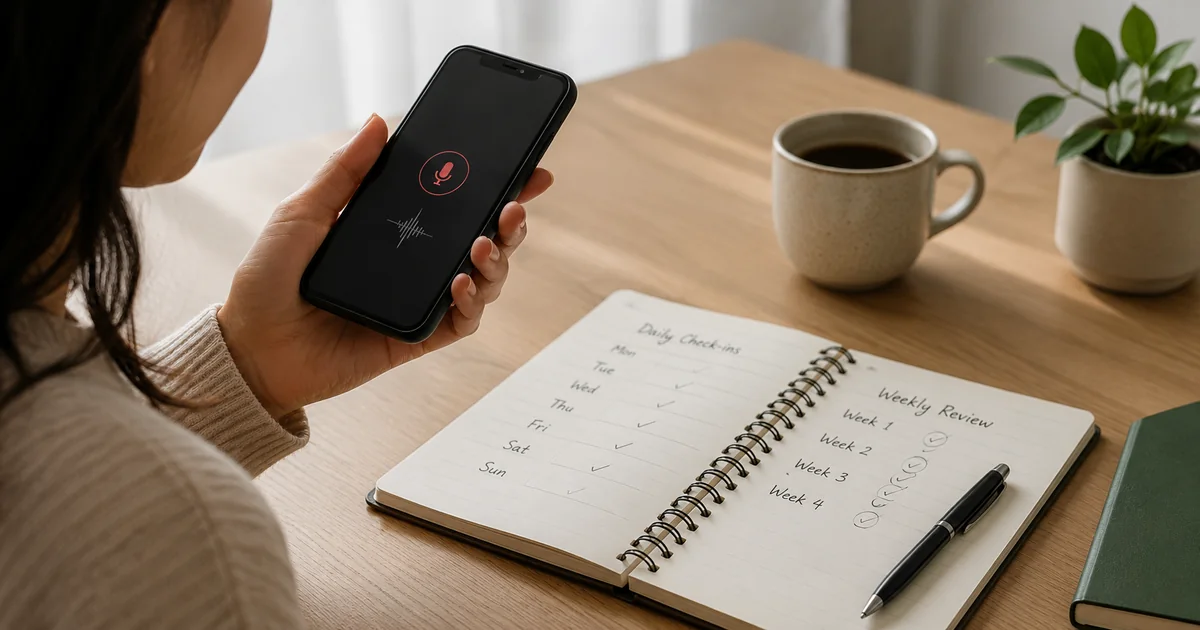
Goals are easier to revisit when reflection has a clear place in your routine. A goal reminder can provide that cue: not by completing the work for you, but by prompting you to pause, record what happened, and decide what should come next.
In JournPad, you can create reminders linked to a specific goal. These reminders can repeat daily or weekly and can include multiple scheduled times. When the reminder brings you back to your goal, you can open that goal and record a new voice entry from within it. The saved entry is then linked automatically to the goal, where it can be reviewed alongside earlier entries.
This creates a simple loop:
- Choose a reflection rhythm.
- Receive the reminder.
- Record a short voice reflection inside the goal.
- Review linked entries to notice progress, obstacles, and next steps.
Why link reminders to a goal?
A general reminder can tell you to journal. A goal-linked reminder gives the reflection a more specific purpose.
Instead of asking, “What should I write about?”, you already know the subject: the goal you are working toward. That can make it easier to begin and can keep your reflections focused on useful questions:
- What progress did I make?
- What got in the way?
- What did I learn?
- What is the next realistic action?
- Does this goal still matter in its current form?
Research on implementation intentions describes the value of connecting an intended behavior to a specific cue or situation. A study of reminder scheduling and daily goal success found that reminders and implementation intentions can influence whether people follow through on planned behavior (Pirolli et al., 2017). Broader research also treats prompts, cues, goal setting, and self-monitoring as common ingredients in digital habit-support interventions (Zhu et al., 2024).
A reminder is not a guarantee, and it should not become another source of pressure. Its practical value is that it creates a repeatable opportunity to check in.
Choose daily reflection when the goal changes quickly
Daily goal reminders are useful when small events, decisions, or emotions can affect the direction of a goal.
A daily check-in may fit:
- a new morning routine
- a short project with frequent changes
- a learning plan
- a creative practice
- a job search
- a personal consistency goal
Keep the reflection small enough to repeat. You do not need a long entry every day. A short voice note can capture the most important update while it is still fresh.
A useful daily structure is:
What happened today?
State the relevant action or event without trying to make it sound impressive.
What helped or slowed me down?
Notice conditions, choices, or obstacles that affected progress.
What will I do next?
End with one concrete action you can recognize and complete.
Habit research commonly emphasizes repetition in a stable context, while also showing that simpler actions are easier to repeat consistently (Gardner et al., 2012). For reflection, that suggests choosing a realistic moment and a short format rather than creating a demanding daily ritual.
Choose weekly reflection when you need perspective
Weekly goal reminders are often better when daily changes are too small to interpret meaningfully.
A weekly check-in may fit:
- long-term professional goals
- fitness or wellbeing routines
- financial planning
- study progress
- business development
- personal projects with several moving parts
Weekly reflection lets you look beyond one good or difficult day. You can compare intentions with what actually happened, notice recurring patterns, and adjust the coming week.
Try these questions:
- What moved this goal forward this week?
- Which action had the greatest effect?
- What repeatedly distracted me?
- What should I stop, continue, or change?
- What is the most important next milestone?
You can also review the entries already linked to the goal or play them as a goal-specific playlist. Hearing several reflections together may make changes in emphasis, confidence, or recurring obstacles easier to notice.
For a broader goal-review approach, see Creating Goal-Linked Voice Journals for Concrete Progress Tracking. You can also explore Simplify Weekly Goal Review with JournPad’s AI Summaries when you want to combine recorded reflections with processed entry summaries.
Use multiple reminder times carefully
JournPad goal reminders can include multiple scheduled times. This can help when your day has more than one natural reflection point, such as:
- a brief intention in the morning
- a progress check after work
- a final reflection in the evening
More reminders are not automatically better. If every alert is ignored, the schedule may be too demanding or poorly timed.
Start with one dependable cue. Add another only when it serves a different purpose. For example, a morning reminder can ask what matters today, while an evening reminder can ask what actually happened.
Adjust the rhythm instead of abandoning the goal
Missing a reflection does not mean the goal or system has failed.
If daily reminders begin to feel repetitive, switch to weekly reflection. If weekly entries feel too distant from important events, use a daily reminder during an active period and return to weekly reviews later.
The best schedule is the one that helps you capture useful evidence about your progress without turning reflection into unnecessary work.
A practical starting plan
Begin with one goal and choose either a daily or weekly reminder.
Use a simple prompt:
What changed since my last reflection, and what is the next useful step?
Record the answer from within the goal so the entry is linked automatically. After several entries, review or play the goal-linked reflections together. Look for repeated obstacles, helpful conditions, and decisions that deserve follow-through.
Goal reminders work best as invitations to pay attention. They give you a consistent moment to turn experience into a record—and that record can help you make the next decision with more context.