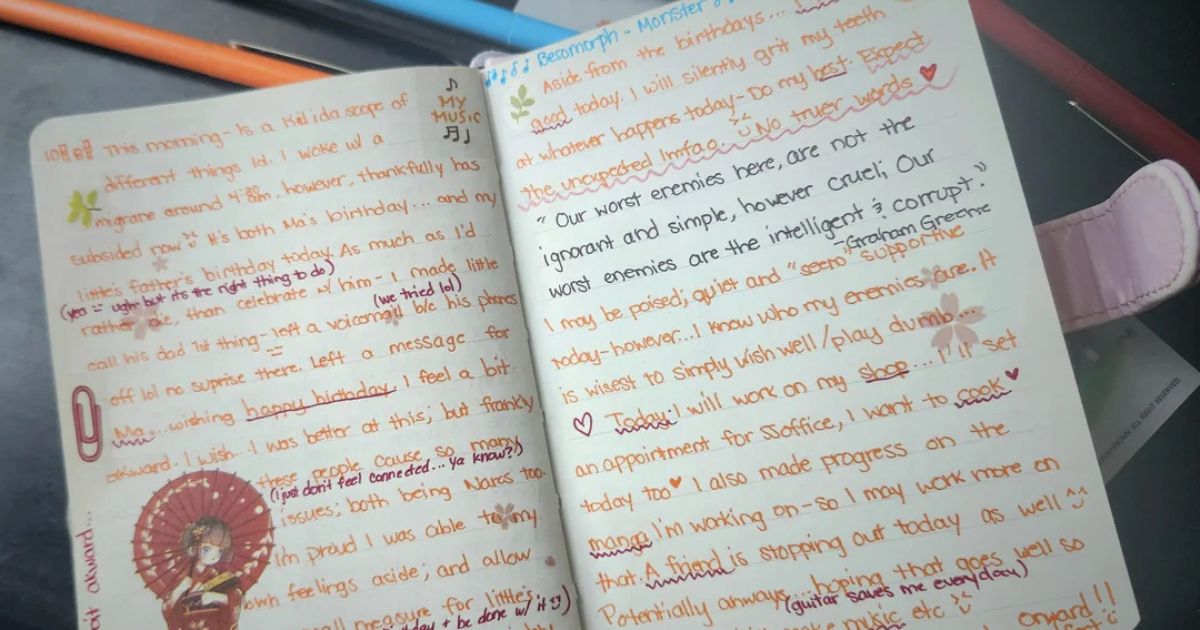
Write your thoughts. Clear your mind. Heal your past. Build better habits.
All of this can be true. But there’s also a side of journaling that very few people talk about: when it makes you feel worse, not better.
Recent research on expressive writing and mental health, plus decades of lived experience from long-time journalers, point to an important nuance:
Journaling is a powerful tool.
Like any powerful tool, it can help you — or hurt you — depending on how you use it.
This article is about the darker side: what can go wrong, why it happens, and how to journal more safely and intentionally, especially when using a tool like JournPad.
When Journaling Becomes Rumination
Several studies in the early 2020s found that unstructured, repetitive writing about negative experiences can reinforce anxiety and depression instead of relieving them.
People described the same pattern:
They sat down to “vent” or “get it out.”
They wrote pages and pages about what was wrong.
Instead of feeling lighter, they felt heavier, angrier, more stuck.
Over time, they realized they weren’t processing their feelings — they were wallowing in them.
Common signs of rumination on the page:
Writing about the same painful situation for months or years, with no new perspective.
Leaving entries in pure anger or despair, with no attempt to zoom out, reframe, or close the loop.
Finishing a session feeling more activated and hopeless than before you started.
The problem isn’t that you wrote about something painful. It’s that you stayed there and kept circling.
The Trap of “Only Writing When Life Is Bad”
Many people only reach for a journal when:
They’re heartbroken.
They’re furious.
They’re anxious and can’t sleep.
Something has gone seriously wrong.
Years later, when they look back, the written record tells a distorted story:
It looks like they were miserable all the time.
This has two big side effects:
You reinforce a negative identity when you reread: “Wow, I was always broken, always failing, always in drama.”
You erase your own joy because the normal days, silly moments, and quiet wins never made it onto the page.
Some long-time journalers have started forcing themselves (gently) to record at least a few lines when they are:
Content.
Proud of something small.
Grateful for something ordinary.
Simply okay.
Even minimal “good” entries help rebalance the story your journal tells you about your life.
When Re-Reading Old Journals Reopens Old Wounds
Expressive writing research shows that for some people, revisiting old traumatic entries too soon can actually re-trigger pain instead of helping them integrate it.
Many experienced journalers report similar experiences:
Discovering, years later, that an old entry describes something they now recognize as abuse or trauma — and spiraling after reading it.
Reliving the emotional intensity of a breakup, loss, or dark period as if it were happening again.
Feeling ashamed or horrified at the self-hatred they once wrote down.
Over the long term, revisiting the past can be clarifying and healing.
But timing matters.
Some people now use “rules” like:
Not rereading any entry for at least 3–6 months.
Skipping entire notebooks from particularly traumatic periods.
Choosing very carefully what to revisit — ideally in combination with therapy or trusted support.
The Fear of Being Exposed
One of the most painful themes that shows up again and again in people’s stories is privacy violation:
A parent reading a teenager’s journal and confronting them about private feelings or relationships.
A partner secretly reading their journal, then breaking up based on raw, unfiltered entries.
Friends or roommates snooping through notebooks left out in the open.
The fallout is almost always the same:
Deep shame.
Loss of trust.
Stopping journaling for months or years.
A constant underlying fear that “someone will read this.”
In theory, a journal is a private space. In reality, paper journals can be picked up and opened.
This doesn’t mean paper is bad — but it does mean your nervous system may never fully relax if you don’t feel safe with where and how your words live.
Journaling That Keeps You Stuck
There’s also a quieter “dark side” that isn’t dramatic, but still corrosive over time.
You might notice that your journaling:
Reinforces a story of “I never change” because you keep writing the same goal and never act on it.
Records every plan and intention, but not the real steps you took.
Becomes a place where you justify your worst behavior and blame everyone else.
Feeds perfectionism: you beat yourself up on the page for not becoming the person your journal says you “should” be.
In these cases, the journal stops being a tool for growth and becomes a record of stagnation.
The problem here isn’t that you’re writing — it’s that writing has replaced action, relationships, and sometimes professional support.
How to Journal Without Spiraling
None of this means you should stop journaling.
It means you may need to change how you do it.
Recent guidance from therapists, coaches, and journaling researchers points to a few protective principles:
Balance the hard with the helpful
It’s important to acknowledge pain honestly — but also:
Look for lessons, boundaries, or next steps.
Add a sentence or two of perspective, gratitude, or self-compassion at the end.
This isn’t toxic positivity. It’s preventing your journal from becoming a shrine to suffering.
Watch for repetition
If you notice you’ve written the same complaint or fear dozens of times with no movement, that’s a signal:
Maybe this belongs in therapy.
Maybe it’s time to act, not just write.
Maybe you need to change how you journal about that topic (less detail, more solution).
Set limits around venting
Some people find it helpful to:
Time-box “worry writing” to 10–15 minutes.
Limit themselves to a single “worry page” per week.
After that, they intentionally switch to a neutral or positive prompt.
Protect your privacy on purpose
Whether you use paper, digital tools, or something like JournPad:
Decide where your most sensitive entries live.
Use locks, encryption, or private accounts.
Be realistic about who might access your notebook — and choose accordingly.
Don’t let journaling replace connection
A journal can be a powerful companion, but:
It can’t give you feedback like a therapist.
It can’t challenge your blind spots like a good friend.
It can’t hold you accountable like a coach or support group.
If your journal is absorbing everything and nobody in your life knows how you actually feel, it may be time to widen the circle.
How JournPad Helps You Use Journaling More Safely
JournPad was designed with these realities in mind.
Instead of just giving you a blank page, it gives you flexible structures that nudge you toward healthier patterns:
You can record quick audio vents when something is intense, without needing to craft perfect sentences.
You can create categories (anxiety, gratitude, therapy notes, wins, goals) so your entire emotional life doesn’t blur into one dark stream.
You can set reminders for balancing entries, like:
A short gratitude recording.
A “wins of the week” reflection.
A check-in on progress, not just problems.
You can review past entries with AI assistance to:
Spot patterns you might be stuck in.
Notice goals you keep writing about but never acting on.
See where you might be too hard on yourself.
And because your entries live in your account — not in a notebook that can be opened on a whim — you gain a layer of psychological safety that many paper journalers never feel.
Journaling Is Powerful. Use It With Care.
The darker side of journaling isn’t about the pen, the paper, or the app.
It’s about:
Writing only when life is bad.
Staying inside the same painful story for years.
Letting pages become a home for self-hatred.
Using your journal as a substitute for action, help, and connection.
Feeling constantly afraid that your most honest words will be exposed.
Journaling can absolutely help you heal, grow, and understand yourself.
It can also amplify your pain if you never balance, integrate, or step back.
With intention — and with tools like JournPad that support healthier patterns — you can keep the benefits of journaling without getting lost in its shadows.
You deserve a journaling practice that helps you move forward, not one that keeps you stuck in the dark.