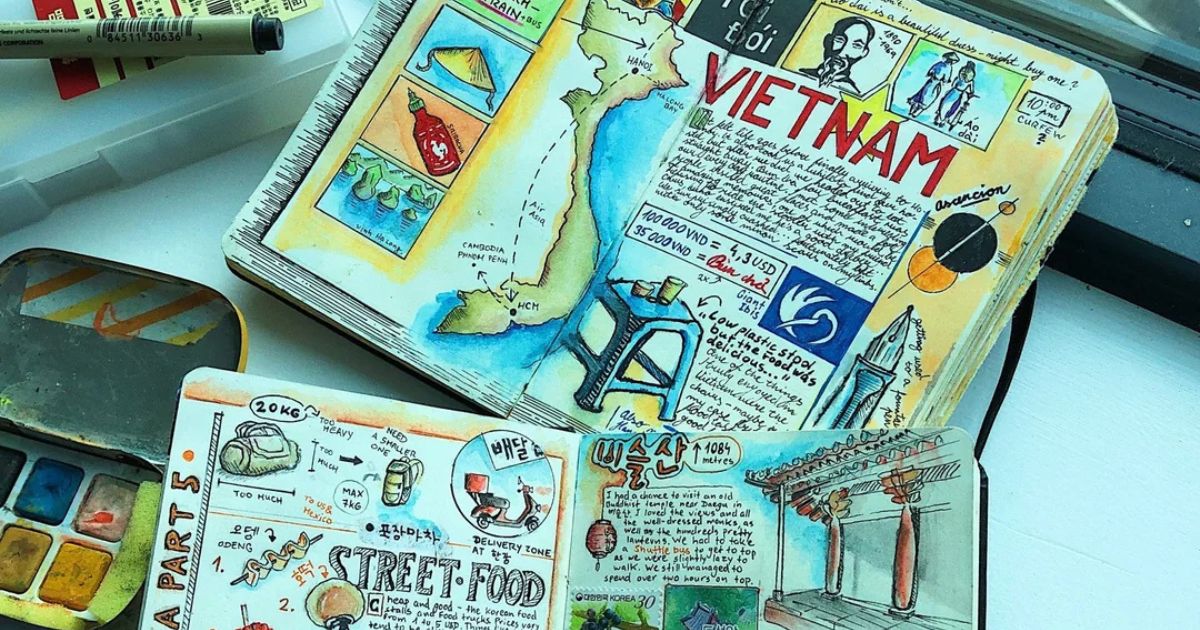
Scroll social media and you’ll see stunning travel journals:
hand‑drawn maps
watercolor café scenes
collaged tickets and handwritten notes
They look like something you’d buy in a bookstore.
They’re also the reason many people quietly think:
“I’d love a travel journal… but I don’t draw, I’m not neat, and I don’t have time.”
Here’s the truth: you do not need to be artistic or disciplined to keep a travel journal that changes how you experience and remember your trips.
You only need:
a place to put your impressions while they’re still fresh
a method that fits your actual travel style
permission for it to be messy, incomplete, and completely private
What a Travel Journal Is Really For
A travel journal is not a performance. It’s a memory amplifier.
Beneath the aesthetics, it serves three quiet but powerful purposes:
Capture
It catches small details that your memory will absolutely forget:
the name of a tiny café, a stranger’s joke on a night train, the exact color of a market at sunset.
Process
Especially when you travel solo, your brain is overloaded.
A journal gives those thoughts a place to land so they don’t just swirl around.
Return
Months or years later, you can step back into those days in far more detail than photos alone can give.
A beautiful illustrated journal is one way to do this.
A scrappy notebook, a notes app, or a stream of voice entries in JournPad can do the same job.
Why Travel Journals Matter So Much for Solo Travelers
When you travel with others, you process your experiences by talking:
“That view was insane.”
“Remember that waiter?”
“I can’t believe we got lost there.”
When you travel alone, most of that happens in your head.
Without an outlet, that can feel like:
mental overload
loneliness, even when the day was good
a blur of places that all blend together later
A travel journal acts like:
a companion you debrief with at the end of the day
a pressure valve for thoughts and emotions
a timeline so days don’t dissolve into one long “trip” you barely remember
You don’t have to write pages.
Even a few focused minutes each day can shift how grounded you feel.
Travel Journals Don’t Have To Be Beautiful To Be Powerful
There are roughly two archetypes you see online:
the artist‑traveler with museum‑worthy pages
the scribbler who says “my journal looks like dog shit, but I’m so glad I kept it”
Both are valid. But for most people, the second is more realistic and more sustainable.
Instead of aiming for art, aim for usefulness.
Useful travel journals tend to include:
Anchors
City, date, rough route, who you were with.
Moments
One or two tiny scenes that really stuck with you: a bus driver’s music choice, a conversation in a hostel kitchen, the smell on a side street.
Feelings
Not just what you did, but how you felt: overwhelmed, peaceful, lonely, proud, surprised.
Those three ingredients are enough to take you back there years later.
Ways to Keep a Travel Journal (No Art Skills Required)
Different personalities need different formats. Choose one that matches your energy and attention span.
Bullet‑style notebook entries
Perfect if you like pen and paper but hate essays.
You can use simple prompts:
Where I went today
People I met
One thing I loved
One thing that was hard
Something I don’t want to forget
Each prompt can be just one line.
If you feel like expanding, you can. If you’re tired, bullets are fine.
Ticket‑and‑scrap collages
If you like physical souvenirs more than writing, collect tickets, receipts, napkins, maps, business cards and glue or tape them next to short notes, for example:
“Met Anna from Berlin on this train.”
“This receipt – the lunch where I finally relaxed.”
“Map of the hike I nearly quit halfway.”
You’re building a visual index of your trip. A few handwritten notes turn a scrapbook into a journal.
Photo‑first, words‑second
If you naturally take lots of photos.
At the end of the day, pick 3–5 photos
For each, jot one or two sentences about:
why you took it
how you felt in that moment
something just outside the frame
You can do this in a small notebook, a note on your phone, or as short entries in JournPad, attaching or referencing the photos.
The key is to pair images with meaning, not just dates and locations.
Purely digital or audio journaling
Some travelers cannot stand the idea of sitting and writing by hand. That’s fine.
You can:
type quick daily notes in an app
keep a private photo + caption feed
record 2–5 minute voice notes
With audio in JournPad, for example, you can:
talk into your phone on buses, trains, or in your bunk before sleep
tag entries with city names, countries, or themes (food, people, mistakes)
later, listen back as a travel playlist of your own voice
You still get all the benefits — without carrying a single notebook.
How To Make It Sustainable On The Road
The biggest reason people abandon travel journals is not lack of inspiration. It’s friction.
A few ways to make the habit survive real travel:
Shrink the commitment. Promise yourself: “One paragraph or three bullet points per day.” Anything extra is a bonus, not a requirement.
Attach it to an existing moment: in the tent before sleep, at breakfast, on a train or bus, while laundry is in the machine.
Allow catch‑up days. If you miss a day or two, don’t quit. Write a “last few days in one go” entry. Imperfect coverage is infinitely better than nothing.
Keep it small and light: tiny notebook, purely digital, or just audio. If the journal feels like luggage, you’ll resent it.
What To Actually Write About
You don’t have to document every step to make your journal valuable.
Some ideas:
First impressions of a new place: smells, weather, sounds, what surprises you.
Conversations: names, languages, jokes, advice you got, things you learned.
Moments of emotion: times you felt afraid, proud, lonely, ecstatic, grateful, and why.
Mistakes and close calls: missed trains, wrong turns, bad hostel picks, travel scams avoided (or not).
Tiny sensory details: a particular song on a bus, the way a streetlight hit a wall, a food you can’t quite describe.
These are the things your brain will not store reliably on its own.
On the page or in an audio entry, they last.
How Travel Journals Age Over Time
Right after your trip, your journal feels like a nice record.
Years later, it becomes:
proof that you were braver than you remember
a reminder of people you’d otherwise have forgotten
material for stories you’ll tell your children or future self
sometimes, a way to see how much you’ve grown since then
People who go back to old travel journals almost always say the same thing:
“I forgot so much until I read this.”
You are writing for a future version of you who will be very glad you did.
Using JournPad As Your Always‑With‑You Travel Journal
For many travelers, carrying extra notebooks, glue sticks, or pens is a dealbreaker. That’s where a tool like JournPad fits naturally.
On the road, you can:
record voice notes in airport gates, buses, hostel kitchens, or quiet corners
tag entries with city names, countries, and themes
add shorter written notes when you’re in a café with Wi‑Fi
later, search across trips for places, people, or feelings you mentioned
Instead of:
“I should really be writing this down somewhere…”
you’re always one tap away from capturing what matters — without breaking the flow of your trip.
You Don’t Need a Perfect Journal. You Need a Real One.
You don’t have to:
draw
paint
write beautifully
log every day
share any of it online
You only have to:
care enough about your own experience to give it a place
choose a format that matches who you are (not who Instagram wants you to be)
keep going, even if some pages or days are missing
A travel journal — whether ink‑stained or audio‑only — is not about proving that you went somewhere.
It’s about remembering how it felt to be there.
And you are absolutely allowed to do that in your own way.